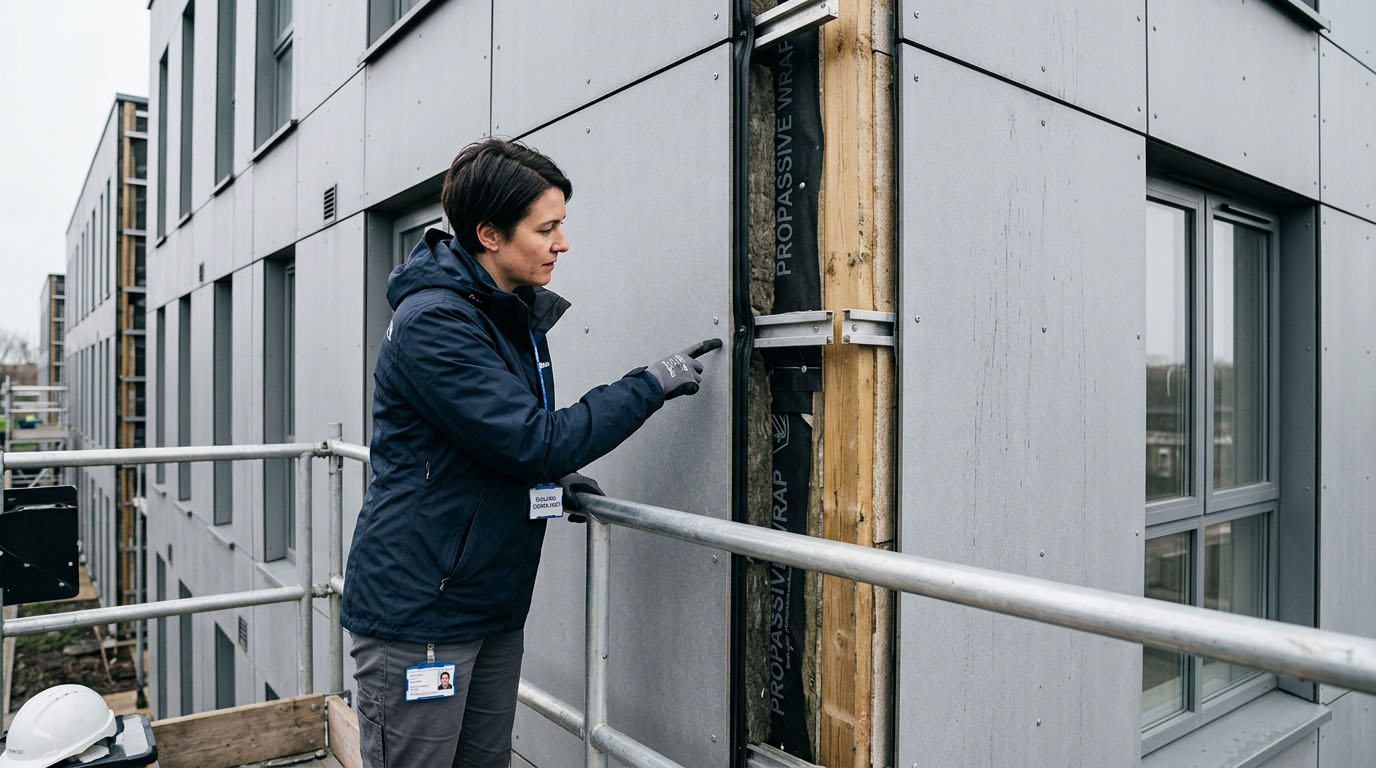
External wall systems — the combined assembly of cladding, insulation, fixings, cavity barriers, and any other components that make up the external envelope of a building — have been under intense scrutiny since the Grenfell Tower fire of 2017. For the owners and managers of multi-occupied residential buildings, understanding who is responsible for assessing, maintaining, and where necessary remediating these systems is not merely a compliance question. It is a question of liability, insurance, and in some cases the safety of residents.
The EWS1 Framework and Its Limitations
The EWS1 (External Wall System) form was introduced in December 2019 as a mechanism to allow lenders and valuers to assess the fire safety of external wall systems in multi-storey residential buildings. An EWS1 form is completed by a qualified professional who has assessed the external wall construction and reached a conclusion about whether remediation is required.
The EWS1 process has been subject to significant criticism — not least because demand for assessments vastly outstripped the supply of qualified assessors, creating a bottleneck that left thousands of leaseholders unable to sell or remortgage. The framework has also been criticised for inconsistency: different assessors applying the same criteria to similar buildings reaching different conclusions, and the scope of what must be assessed varying between assessors and instructions.
Notwithstanding these limitations, EWS1 assessments remain a practical reality for many transactions involving residential buildings above 11 metres in height. Building owners who do not have a current EWS1 form should expect lenders to require one before mortgage applications can proceed on any unit in the building.
The Accountable Person's Obligations Under the BSA
For higher-risk buildings — those 18 metres or above, or seven or more storeys, containing at least two residential units — the Building Safety Act 2022 places the primary obligation for managing fire and structural safety risk with the accountable person (AP). This obligation extends explicitly to the external wall system. The AP must assess the fire risk presented by the external walls and roof of the building and include that assessment within the Building Safety Case.
For buildings that have previously received an EWS1 assessment, the Building Safety Case assessment and the EWS1 assessment are related but distinct exercises. The EWS1 form addresses the question for mortgage lending purposes; the Building Safety Case assessment must address the question as a matter of ongoing safety management and regulatory compliance.
"An EWS1 form answers the mortgage lender's question. The Building Safety Case answers the regulator's question. They may reach the same conclusion — but they are not the same exercise, and an ageing EWS1 form does not discharge the accountable person's obligation to manage the risk."
Identifying the Responsible Party
One of the most persistent sources of confusion in the external wall system context is the question of who bears responsibility for the cost and management of remediation. The short answer is that it depends on the nature of the defect and the tenure structure of the building.
Where a defect arises from the original construction of the building — defective materials, inadequate design, or non-compliant installation — liability may fall on the developer, the contractor, the architect, or the product manufacturer, depending on the contractual and tortious circumstances. The Building Safety Act introduced new routes for leaseholders to pursue remediation costs against developers and their associated companies, including through the new Building Liability Orders provisions, and extended the limitation periods for certain construction defect claims.
Where no claim against a third party is available — for example, where the building predates modern standards, or where the developer is insolvent — the position is more complex. Leaseholders in affected buildings that fall within the scope of the Cladding Safety Scheme (formerly the Building Safety Fund) may be eligible for government-funded remediation. Buildings outside that scope must rely on the accountable person taking action, with the costs ultimately borne through service charges unless alternative funding is secured.
The Leaseholder Protections Under the BSA
The Building Safety Act introduced significant protections for qualifying leaseholders against being required to pay for the remediation of certain historical building safety defects. In broad terms, a qualifying leaseholder — one who owned the property as their main or only home on 14 February 2022, or who is not a developer or associated person — cannot be required to pay remediation costs for cladding defects through the service charge.
The protections also extend beyond cladding to non-cladding building safety defects where the accountable person or a relevant landlord is responsible. The legislation is complex and its application to individual circumstances requires careful analysis, but the headline position is that the costs of remediating historical external wall defects should not fall on qualifying leaseholders in the same way they did before the Act.
Surveys and Assessments: What Is Required?
An external wall system assessment typically involves a combination of desktop review of the original construction documents, intrusive survey work to confirm the actual build-up where documentation is absent or inadequate, and a fire engineering assessment of the resulting information against the applicable standards.
The scope of the intrusive survey is often a point of contention. Accessing the external wall construction requires opening up works — removing cladding panels, lifting soffits, or coring through the wall at representative locations — which is disruptive and costly. The temptation to minimise survey scope is understandable, but an assessment based on inadequate survey data is only as reliable as the assumptions it makes.
For the purposes of a Building Safety Case submission, the Building Safety Regulator expects the assessment to be based on adequate evidence of the actual construction. A desktop review of original specifications will not suffice where there is reason to believe the as-built condition may differ, or where documentation is incomplete or unavailable. Independent verification of construction quality during the assessment process is increasingly regarded as necessary for higher-risk buildings.
What Building Owners Should Do Now
For building owners and accountable persons who have not yet addressed their external wall systems, the practical steps are: commission an external wall assessment scoped appropriately to the building's height and complexity; establish the as-built condition of the wall construction through intrusive survey where documentation is inadequate; assess the fire risk and determine whether remediation is required; and develop a remediation programme if it is, with appropriate prioritisation based on risk.
Where leaseholders are involved, the accountable person must be prepared to demonstrate compliance with the leaseholder protection provisions and to communicate clearly with residents about the process and timeline. The Building Safety Regulator's expectations around resident engagement apply fully in this context.