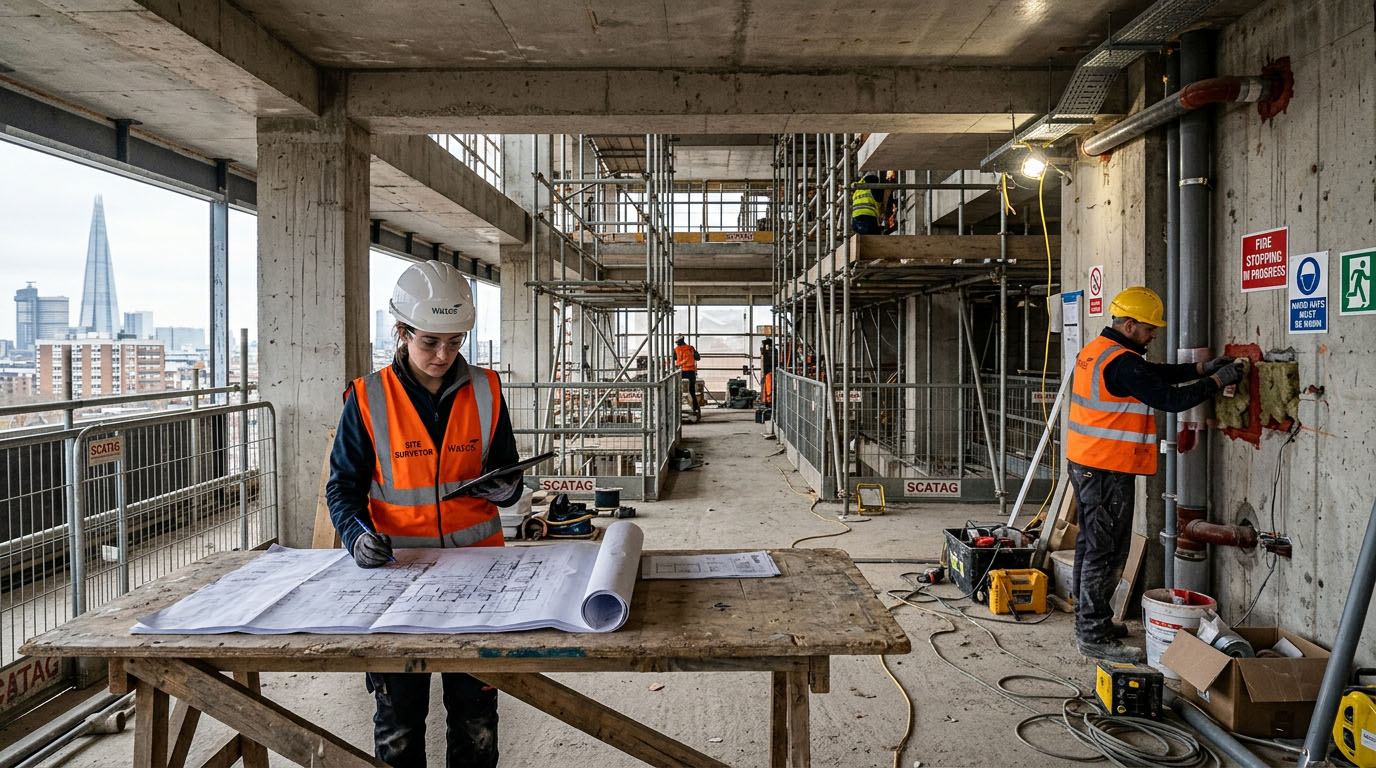
Approved Document B — the guidance underpinning Building Regulations Part B — sets out the fire safety requirements for most buildings in England. During refurbishment works to higher-risk buildings, compliance failures are more common than many clients anticipate. In our experience reviewing works across the UK, the same categories of problem recur. This article sets out the pitfalls we encounter most frequently and what design teams and contractors can do to avoid them.
Understanding What Triggers a Part B Assessment
A common misconception is that Part B only applies to new builds. In fact, any material change of use, material alteration, or building work to an existing higher-risk building will engage Part B obligations. The determination of what constitutes a "material alteration" is often the first point of difficulty. Works that affect the building's means of escape, compartmentation, or structural fire resistance are clearly within scope — but seemingly minor changes such as reconfiguring an internal partition, installing a new mechanical services riser, or altering a floor plan can also trigger full Part B consideration.
Designers who fail to flag this at the outset leave the client exposed. We regularly encounter situations where works have been completed without adequate Part B consideration, requiring expensive retrospective remediation to achieve compliance.
Compartmentation Failures
Compartmentation — the subdivision of a building into fire-resisting zones to limit the spread of fire and smoke — is the single most common source of failure during refurbishment projects. The issue is almost always penetrations: services, cables, pipes, and ductwork passing through compartment floors and walls without adequate firestopping.
When refurbishment works involve new mechanical and electrical runs, contractors who are not briefed on compartmentation requirements will simply run services through the most convenient route without sealing penetrations to the required standard. We have reviewed buildings where dozens of compartment penetrations have been left unprotected following a refurbishment that was otherwise well executed.
The solution is straightforward: firestopping must be specified on drawings before works commence, inspected during installation, and signed off before any works are concealed. A third-party firestopping inspection at this stage is far less costly than accessing concealed voids after practical completion.
Cavity Barriers
Concealed spaces — roof voids, floor voids, and cavity walls — allow fire and smoke to travel rapidly through a building without triggering detection. Approved Document B requires cavity barriers to interrupt these pathways at defined intervals and at junctions with compartment elements.
During refurbishment, cavity barriers are frequently omitted, displaced, or damaged. Thermal and acoustic upgrades to facades, loft conversions, and raised access floor installations are all common contexts where existing cavity barriers are disturbed without reinstatement. If the presence, location, and integrity of cavity barriers is not captured in the pre-works survey, their absence will almost certainly go unnoticed until a fire or an enforcement inspection reveals it.
"We consistently find that the buildings with the best overall fire safety compliance are those where fire strategy was considered by a competent consultant at design stage, not reviewed for the first time when a defect emerges."
Fire Doors: Specification and Installation
Fire doors are one of the most visible and frequently defective elements of fire compartmentation. The problems we see fall into three categories: incorrect specification, poor installation, and inadequate maintenance following handover.
Specification errors include selecting a door with an insufficient fire resistance period for the compartment boundary it serves, or failing to account for the full door set — frame, ironmongery, seals, and glazing all contribute to the door's certified performance, and any non-certified substitution voids the rating. Installation errors include incorrect clearances, missing or incorrectly positioned intumescent and cold smoke seals, and improperly adjusted door closers. A fire door that does not close and latch under its own weight provides no meaningful protection.
Structural Fire Protection
Structural steel in existing buildings often has applied fire protection — intumescent coatings, board systems, or sprayed mineral fibre — that may be disturbed, damaged, or removed entirely during refurbishment. Where structural members form part of a compartment floor or wall, or where failure would cause progressive collapse, the integrity of this protection is critical.
Before works proceed, an assessment of the existing structural fire protection should establish its current condition, the required standard for the building's use and height, and any remediation needed. Post-refurbishment sign-off should include inspection of all structural fire protection affected by the works.
Getting It Right Before Sign-Off
The most effective intervention we make is at design stage, before any works begin. A fire strategy review at RIBA Stage 2 or 3 allows compliance issues to be resolved in drawings rather than on site. Where that opportunity has passed, a pre-completion inspection — reviewing compartmentation, cavity barriers, fire doors, and structural fire protection before works are signed off and concealed — remains far more cost-effective than post-occupancy remediation.
If you are planning a refurbishment to a higher-risk building and would like an independent assessment of your Part B compliance approach, our building regulations consultants are available to review your proposals and advise on any areas of risk.